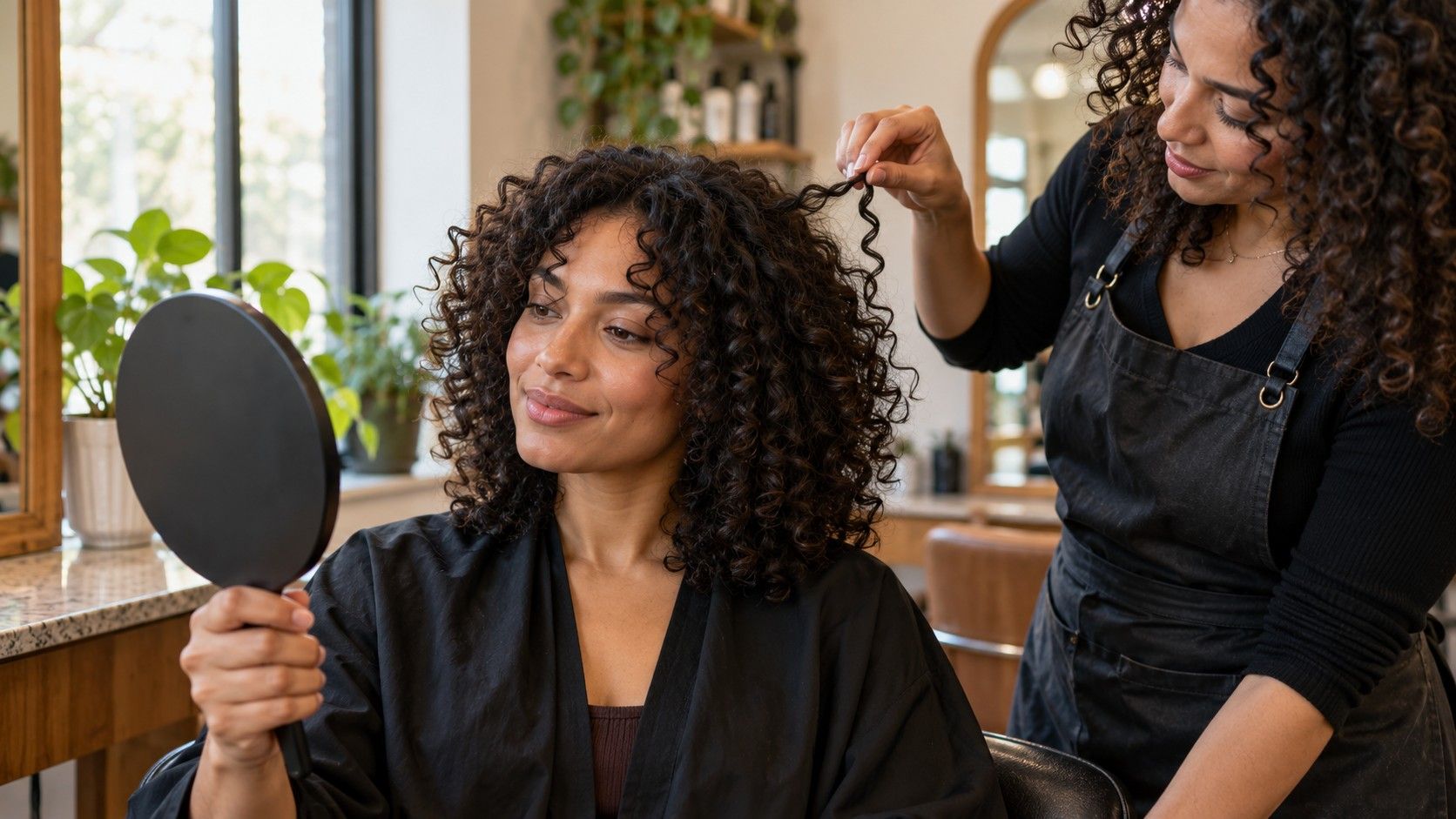
A curly-hair preview is easy to misread when the reference photo shows a different routine or curl state from yours. Start with curls as you normally wear them, separate dry shape from stretched length, and use the image to frame questions for a stylist. The goal is a clearer comparison, not a promise of an exact result.
Start with curls in their usual state
A hairstyle preview can only compare well with the photo you give it. For curly hair, choose an image that resembles how you normally wear your curls, not a rare blowout or a wash-day result you never repeat. If your routine includes a leave-in product and air-drying, use a photo after that routine. If you wear your hair stretched most weekdays, choose a representative stretched style and bring a natural-curl reference too.
Look for a photo taken after the curls have dried and settled. Wet curls often hang longer and group differently, while freshly styled curls can have more definition than they will later in the day. Neither state is wrong; they answer different questions. A dry, everyday photo is often the practical starting point for discussing the silhouette you see in the mirror.
Keep the camera near eye level, face the lens, and make sure the sides and ends are visible. A top-down angle can hide the outline, while a close selfie lens may change proportions at the edges of the frame. Move hair away from the face only if that is how you want to examine the framing; otherwise, leave your usual part and front pieces in place.
One photo rarely tells the whole story. A front view helps compare the overall shape, and a side view shows how the cut sits around the crown, ears and nape. If a preview accepts one image only, use the clearest everyday front view and treat side details as questions for the consultation. Consistent lighting and a plain background can make the outline easier to see, but do not flatten or alter curls just to make the photo look tidy.
Account for shrinkage before comparing lengths
Curly hair can appear shorter when it dries and coils than when it is wet or gently stretched. The amount varies with curl pattern, length, condition, styling and handling, so a single estimate cannot tell you exactly where a cut will land. When looking at references, check whether the hair is wet, stretched, diffused or air-dried. “Shoulder length” can describe very different visible lengths in those states.
Compare the dry silhouette with the stretched length as two separate views, not as competing versions of the truth. Dry curls show the volume and outline you may wear most often. A stretched view helps communicate how much length is present when the curl is elongated. If you use a preview, note which state the source photo represents and avoid judging a new cut from a reference photographed in another state.
The ends provide practical landmarks. Rather than saying only “take off a few inches,” point to where you want the dry shape to sit: above the shoulders, near the collarbone, or at another visible point. Then ask the stylist how stretched length and shrinkage may affect that target. These landmarks still need interpretation on your own hair, but give both of you something concrete to discuss.
Major length changes deserve a careful conversation because curls can spring up differently after weight is removed. A small trim and a large restyle are different decisions. If you are uncertain, ask how the proposed cut will look when dry and whether you can remove length gradually. That is a choice about comfort and communication, not a promise that a gradual approach suits every haircut.
Compare dry and stretched views for different reasons
A dry reference is useful for shape: where the widest point sits, how the ends curve, and whether the outline is rounded, layered or compact. A stretched reference is useful for length and distribution: how far the hair reaches when elongated, how dense the ends appear, and whether one area is noticeably shorter. Keeping those purposes separate helps avoid asking one image to answer everything.
When comparing photos, check how each was styled. A diffuser, twist-out, braid-out, stretched blow-dry or simple air-dry can create different volume and definition. These looks may all be part of one person’s routine, yet they do not show the same haircut in the same condition. Make a small note beside each reference: dry natural curls, stretched, or styled with a particular method.
| View | What it helps you judge | What it cannot settle alone |
|---|---|---|
| Dry everyday curls | Usual outline, volume and face framing | Exact stretched length or another routine |
| Gently stretched hair | Length distribution and ends when elongated | Everyday curl shape after drying |
| Side and back views | Shape around the crown, ears and nape | How the front frames the face |
| Virtual preview | Broad silhouette and a first comparison | Precise curl behavior or guaranteed salon outcome |
The table is a sorting aid, not a grading system. If your preferred look is a twist-out, bring that example because it is relevant to your routine. If you want to change how you wear your hair, say that too. A stylist can help distinguish a change in cut from a change in styling, and you can decide which part of the reference matters most.
Look for changes in curl pattern and outline
A preview may smooth, repeat or simplify texture in its image. Check whether the curls still look like yours at the roots and ends. If the simulated style has loose waves while your hair forms tighter coils, the preview might still help with approximate length or framing, but it says less about how that texture will sit. Treat the mismatch as a limit on interpretation, not a verdict on the haircut.
Look at several areas separately: crown, sides, front pieces and perimeter. Layers can distribute weight and change where curls expand, but the effect depends on density and cutting technique. A rounded outline in a reference may come from its shape, its styling, or both. Ask which details are likely to come from the haircut and which require a particular routine.
Growth direction and curl grouping matter as well. A part that falls naturally to one side may create a different balance from a centered part in a preview. Some curls clump together; others separate more. A still image cannot show how hair moves when you turn your head or settles after a few hours, so note the parts you want to discuss in person.
Watch for a gap between the image and your maintenance habits. A defined fringe or sharply shaped perimeter may need regular attention, and some looks rely on sectioning or styling that takes time. Ask what the cut would look like on a low-effort day and what products or tools, if any, are needed to get closer to the reference. The answer should fit your hair and routine, not a generic promise.
Take the preview to a curl-aware consultation
Bring a small set of references rather than a long scroll of similar pictures. Include one front view and one side or back view when available, then explain the detail you want to keep: length, rounded shape, fringe, or movement around the face. Tell the stylist how you usually wash, dry and style your curls. Those details help translate a picture into a cut that belongs to your hair.
Ask whether the shape should be assessed on dry curls, stretched sections, or through a combination of methods. Stylists use different approaches, and the right choice can depend on the cut and the hair. A dry assessment lets you see the curl pattern as worn; a stretched check can make length distribution easier to inspect. It is reasonable to ask what the stylist plans to evaluate and why.
Use plain, observable requests. “I want the widest point a little higher,” “I would like to keep enough length to tie it back,” or “I do not want the front pieces to spring above my cheek” gives more context than a haircut name alone. If you have a must-keep feature, say it before cutting begins. If you are open to change, identify the part you are willing to adjust.
A virtual hairstyle preview is a conversation aid, not a forecast of exact salon results. Your curls may respond differently from the digital image, and the finish depends on technique, growth, care and styling. When expectations are clear, a reference still does useful work: it helps you point to a silhouette, compare alternatives and ask better questions before choosing how much to change.